
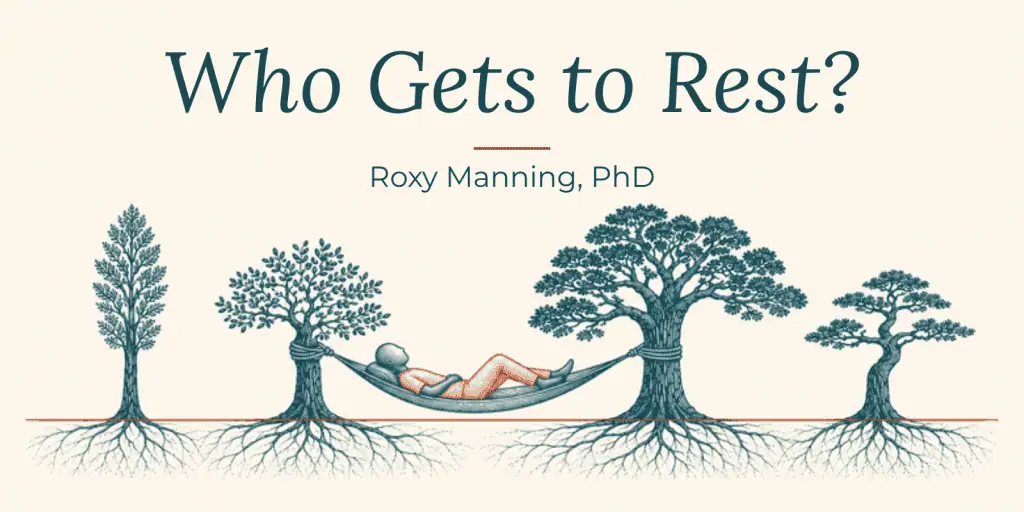

I teach three layers of observation: what we can see around us, what we notice inside ourselves, and what the larger systems show. One way I look at that third layer is Systemic Constellations, a group method where people stand in for family members, groups, and other parts of a system. This can include forces in a family’s or system’s history. It can help us see patterns that are hard to see from the inside. I have been looking at rest through all three layers.
What I saw
I grew up watching my parents work. My dad worked second shift. Then he took care of us while he studied for a new career as a 7A administrator in New York City. 7A administrators were assigned to take over the management of buildings held by slumlords, so that people could have more humane and appropriate housing. My mom worked as an in-home nanny, went to school, and worked with my dad to care for us children and our home.
One image stays with me. It is a holiday and my parents are up at two in the morning, still cleaning the house to make it perfect for us. They had already worked all day. This work was for themselves and for us, to make our home beautiful. For me, that image carries a message. It is not good enough to just rest. You have to work and work until everything is perfect.
I have watched other Black folks I love and respect work the same way. Rest was what came after the work but the work did not end.
What I notice in myself
I carry this. I work at my computer until very late almost every night. I get about five hours of sleep. I do not have a bedtime. When I have fallen asleep at my computer three times, I stop and go to bed.
When I stop, I hear the word lazy. I ask whether I have worked hard enough and whether I am good enough. I know those messages from the inside. I also ask where that word comes from and who is saying it.
What the larger systems show
Those questions took me beyond my own family. Much of the work enslaved Black people did was not for them. It built wealth for other people. In the same country, Black people have been called lazy for generations. Psychologists have tracked this stereotype for nearly a century. In a famous 1933 study, college students were asked to choose the words that best fit different groups. About three in four chose lazy for Black people. When researchers revisited the question in 1995, they found people still knew the negative stereotype. These studies show what people were taught to expect, not what is true.
Rest shows the same pattern. In the United States, a study in JAMA Network Open looked at national surveys from 2004 to 2018. Across those years, Black adults were the most likely to report sleeping fewer than seven hours a night. By 2018 the share was about 11 percentage points higher for Black adults than for white adults. The gap looked biggest for Black women and for Black adults with middle or high incomes. The authors say efforts to close this gap may fall short unless they address systemic racism as a root cause.
So when I cannot stop, I know I am carrying more than my own habits. How did we inherit the idea that we must work? Who gave us that message? I cannot answer these questions fully here. What I can share is how I have started to think about the people who came before me.
Changing my relationship with rest
I have come to believe that my ancestors worked as hard as they did for us. They hoped we would have lives that are truly fulfilling and truly joyful, lives that no longer require us to labor for other people at significant cost to ourselves.
How do I know this? Some of it comes from my own work with Systemic Constellations. In a constellation where I was the seeker, the person whose question is being explored, people stood in as representatives for my ancestors, who were forced to labor for other people; for capitalism; for my parents, who gave up their dream to provide for us; and for me. Watching the representatives interact, I noticed how much I had absorbed the belief that work equals value. With support to untangle the story that a good person does what is needed no matter the cost, I received a clear message: my ancestors wanted me to have choice and to choose what brings me joy.
The people in my life reinforced the insight gained from my constellation work. My parents wanted us to have that choice too. The Black elders around me celebrate what I have accomplished. They also tell me they are concerned and they want to see me living a life with more joy in it.
Even though I believe this, I still find it hard to live as they hoped. I notice how much I still work and I worry about what I am passing on to my children and to the generations who will come after me.
What Systemic Constellations can show
Constellation work is one way I am trying to change this pattern. In the Systemic Constellations work Sarah Peyton and I do together, we ask what vows we have made to honor the people who came before us. Some vows honor a lineage by repeating its hardest years. A vow such as “I will work as hard as you did and never stop” can come from deep love. It can also honor our ancestors in a way they would never have wanted.
Questions like these are part of why Sarah Peyton and I are leading Roots and Branches again this March. It is a three-day intensive for Global Majority participants, March 19 to 21, 2027, in San Lorenzo, California. We use Systemic Constellations to look at how personal experience, family history, racism, migration, and survival can be carried across generations and show up in our lives now. By Global Majority, I mean people who identify as Black, African, Asian, Brown, Arab, or of mixed heritage, who are Indigenous to the Americas and the global south, or who have been racialized as a non-white “ethnic minority.”
Sarah shared why this work matters to her:
The more a constellation facilitator and a constellation circle can see the historical and systemic impacts on a client’s life, the fuller the experience of being seen and known is for the client. Many constellation experiences happen in largely white spaces, where representatives and facilitators do not have an embodied knowledge of these impacts. It can be hard to find constellations in largely Global Majority spaces. I would like to live in a world where everyone has access to constellation work done by and with people who have an embodied understanding of one another’s lives. I am grateful that Roxy has created this opportunity. I am also grateful to Marc Scruggs, whose bequest provides the funds that Roxy and I are using as seed money to start a multi-year Global Majority constellations retreat experience.
Sarah Peyton
Join us on Saturday
If you have never experienced a Systemic Constellation, it may be hard to imagine what happens. On Saturday, November 7, from 9:00 to 10:00 am Pacific, Sarah and I are holding a free Q&A for your questions about what gets passed down in families and what Systemic Constellations can show. You do not need any experience. Curiosity counts as a question.
If you are white, you are welcome at the Q&A. There are other ways to support this work too. You can share it with Global Majority people in your life or contribute to the seed fund that makes future intensives possible. The online session with Francesca Mason Boring on March 27 is open to the wider community.
Reflection questions
- Who in your family got to rest, and who kept working so others could?
- What did the people before you work for? What did they hope your life would hold?
- What do you hear when you stop? Where does that voice come from, and who gains when we believe it?
- What vow might you have made to honor those who came before you? Would they have wanted it?
- Who gets to rest in the places you live and work, and who does not?
Questions to bring on Saturday
- What do you wonder about how Systemic Constellations work or what they can show?
- How might this work sit next to the ways your family or culture already honors ancestors?
- What makes you hesitate about looking at your own lineage?
- What would you like to know about being a representative in someone else’s constellation?
- If you are curious about facilitating this work, what would you want to ask?
These are questions I am still living with. I hope you bring yours on Saturday.
- Register for the Q&A and send a question
- Apply for Roots and Branches if you identify as Global Majority. Apply by Sunday, November 22 for first consideration. You will hear from us by Saturday, November 28.
- Join the March 27 session with Francesca Mason Boring
- Contribute to the seed fund. Contributions are not tax-deductible, since Roxanne Manning LLC is not a nonprofit.