


Four Black elders, one graduation, and what they came to witness
On graduation morning, I arrived at seven o’clock, for doors that would open at eight, for a ceremony that would not begin until ten. I was sick, a cold and pink eye both, and nothing on earth was keeping me out of that room. I spread jackets and bags across a row of good seats and stood guard over them, because four Black elders were on their way, and they had earned a clear view.
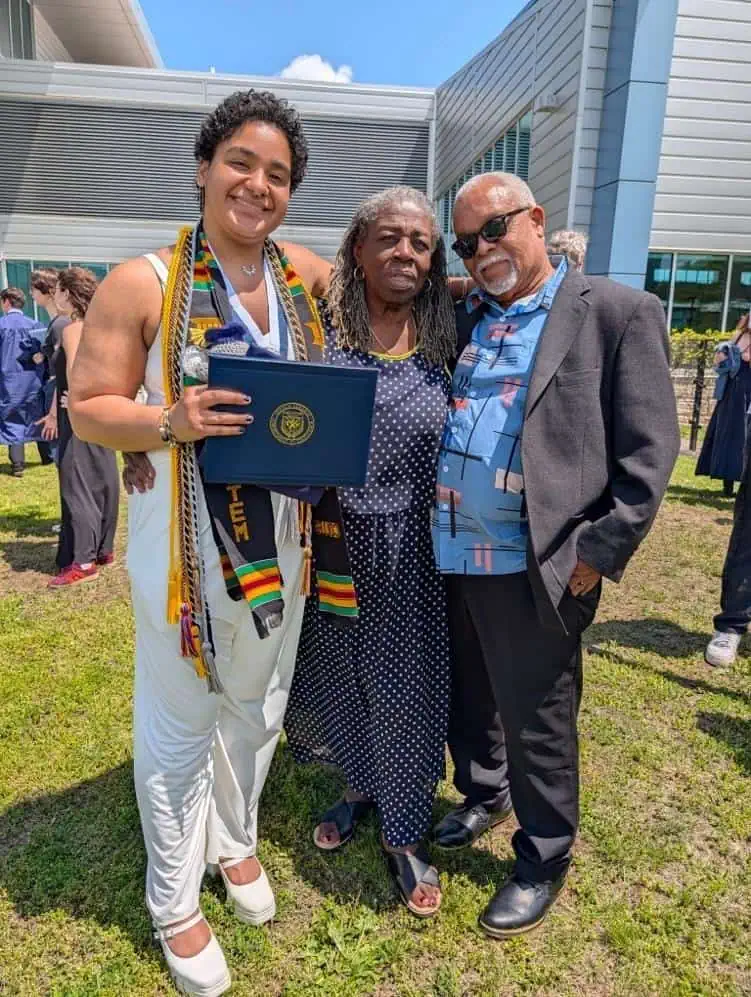
They had all driven. Gwen and Roger, chosen family, came from Ohio. My mother, Lois, who is 78, and her husband, Tony, drove up from Florida. Between the four of them they hold more than three hundred years of life in this country and the Caribbean, and they put their bodies in cars for days to spend one morning watching names be called.
The name they came for belongs to my child, Anika. They are twenty-one. They earned their bachelor’s degree in clinical health studies at Ithaca College in three years, magna cum laude, and their third year of college was also the first year of their Doctor of Physical Therapy program. In two more years, they will be a doctor.
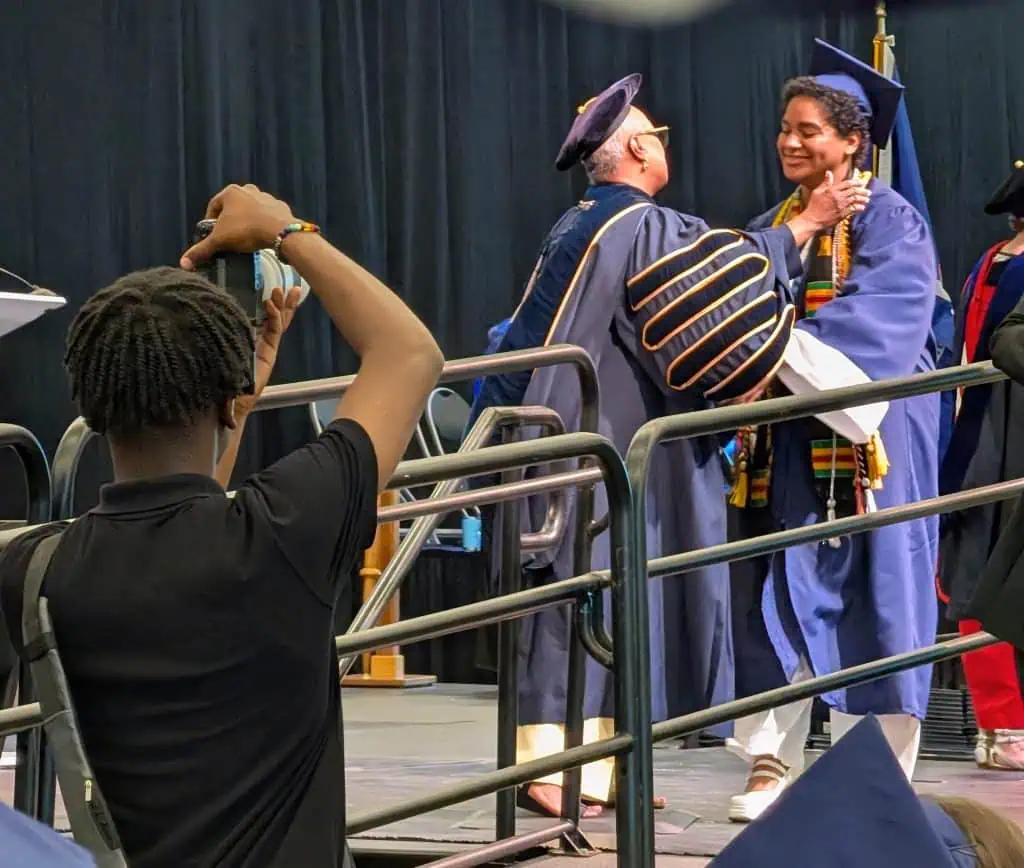
The ceremony ran three hours. Nobody in our row slept. Everybody leaned forward, holding one name, and when it finally came, our whole row rose up shouting. Anika crossed the stage beaming, one fist pumping the air. The college’s president, a Black woman who had fist-bumped most of the graduates as they passed her, opened her arms instead and drew Anika into a hug. I have been thinking about that hug ever since.When I asked Gwen why it mattered to be there in person, she did not talk about the ceremony at all. “Just to show them how much they mean to us,” she said. “That they are important to us, and that we love them, and to be one of the crowd that lifted them up to be seen by the rest of the world. Look at what this baby did.”
In the weeks after graduation, I interviewed three of the four. (Tony was asleep when I called, a right he has thoroughly earned.) I wanted to understand what they saw when they watched Anika walk. What I heard was larger than pride. Each of them, without any prompting from me, turned a family celebration into testimony. Anika’s degree became evidence in an argument this country has been conducting about Black people for four centuries. So this article is mostly their testimony, in their own words, because their words need no improvement from me.
Lois: Two Credits
My mother grew up in Trinidad, in the West Indies, the second of seven children. When her father got sick, her mother had to go out to work, and someone had to stay home with the younger ones. “My older sister didn’t want to stay home,” she told me, “so I stayed home so that my mother could go out to work.” She was thirteen. That was the end of her formal schooling in Trinidad.
She is the only one of the seven who never got a full education. The siblings who came after her became nurses and professionals; one brother became the public relations officer for Texaco. “Everybody after me had the opportunity to get educated and get good jobs,” she said. When I named the sacrifice out loud, that she stayed home so the others could rise, she answered in four quiet words: “It seems that way.” Later, she let me a little further in. “I’m not going to sit and say that I was happy all the time, knowing that I didn’t have the same educational benefits that my siblings had. But it felt good that when my mother needed me the most, I was there for her.”
She and my father, Milton, decided their children would grow up inside the American education system, so that when we were ready for its higher reaches, we could move through them without interruption. She came ahead of us, babysitting and cleaning houses while we stayed behind. “It was a matter of survival,” she said. “My kids were still in Trinidad, and I wanted to make sure that I had a good foundation for them when they came to America.” She left three children behind to build that foundation. I was three years old when she got on the plane. I was seven when I joined her in America. I am one of the children she crossed the water for.
Some employers tried to shrink her, telling her domestic work was the only thing she would ever be able to do. She held on to something Milton used to tell her: “You might be hungry, but you’re not starving, so you don’t have to take abuse from anybody.” She never stayed in an abusive workplace. She had a plan.
The plan unfolded the way plans do when someone refuses to stop. The Equal Opportunity Center, where a teacher drilled her in typing and office skills and would hand back imperfect work saying, “Unh unh, this is not you.” Office jobs. The Metropolitan Opera Guild, where a director corrected her kindly and then wrote the recommendation that took her to a Wall Street firm. Eventually, her own business. And alongside the work, classes at City College, until she stood two credits short of a bachelor’s degree.
Two credits. “I had a problem with statistics, and one younger kid in the school embarrassed me,” she said. “I felt ashamed, and didn’t go back.” A woman who left school at thirteen so her family could survive, who crossed an ocean and built a foundation for her children out of other people’s housework, came within two credits of a degree, and a single moment of public shame ended it. What she did not have, in that statistics class, was one person to stand beside her shame and say, stay.
When I first asked her about racism, she waved it away. “I really didn’t experience it,” she said, and credited her disposition. Trinidad had its own hierarchy; she remembers a classmate telling her she was dirty because her skin was darker. But her teachers were Black and Indian, education was pushed as a birthright, and her worth as a Black person was never the question on the table. Then she kept talking, and the structure she said she never experienced assembled itself out of her own stories. The supervisor at the Opera Guild who told her she had been hired because “we needed a diversified place of work,” then critiqued everything she touched. The employers who held immigrant workers’ passports to keep them compliant. By the end of our conversation she was naming it without my help: “Racism is a far cry from what I experienced in Trinidad. Here, it is like an everyday fact of life in America.”
When I asked where her steadiness came from, she went straight back to her mother’s kitchen in Trinidad. “Mommy talked to everybody. Mommy helped everybody, even though we were dirt poor. If you came to the house, she fed you.” Her mother had a saying: “Even though you don’t have as much as the average person, it does not take skin off of your back to be kind and polite.” That inheritance, a dignity that does not depend on circumstances, is what Lois carried across the water and handed to her children. It is the thing the country could not give us, and she could.
She has watched that inheritance compound. She watched me become the first doctor in her family, a PhD psychologist. Now she has watched Anika, in cap and gown, already one year into a doctorate of their own. “I am proud. I am proud. I did not finish, but in hindsight I did a lot. I got the basic education that allowed me to have a good life and to provide, and it makes me feel proud that my children and my grandchildren are taking education one step further.”
Then she laughed, telling me about her first great-granddaughter, who “called me crying when she got a B in her class, because, according to her, that’s failing, that’s not what her goals are.” Four generations from a girl who left school at thirteen so her family could eat, the children are crying over Bs. That is what a foundation does.
Gwen: The Sticks
Gwen grew up in Akron, Ohio. Her parents had been sharecroppers in the South, “which for me is just slavery 201, as opposed to how people paint it.” Her mother went to the fifth grade. Her father went to the fourth. “They always saw education as the way out of the lives that they had, where it was deprivation and hunger and homelessness, and on and on and on.” Her brother was the first person on either side of the family to finish college. For Gwen, “it never was a question for me that I wasn’t going to go to college. It was expected.”
She did not know she was Black until she was seven. For Halloween she had a Cinderella costume, a white face mask, blonde hair, and the children marched around the school in their outfits. A teacher looked at her and said, “Well, yeah, you have on Cinderella, but your arms are still black.” “I was shocked,” Gwen told me. “I thought I was just like the other kids until they pointed out to me that my mask and my arms did not match.”
The world had been telling her earlier, in a quieter language. In first grade, the class was given instruments. “For the whole year I never got anything but sticks that you would beat together, and I would notice the pretty blonde white girl would get the triangle, which everybody wanted, or somebody would get the drum or some instrument that was better than those sticks. I didn’t know what was going on, but I knew there was something different about me.”
That difference was enforced outside the classroom, too. Gwen’s mother had insisted she attend the predominantly white school, because she knew the all-Black school would not receive the same resources. She was right. When Gwen was seven or eight, the Lone Ranger visited her school to encourage the students to buy bond stamps. It was the most exciting moment of her young life. But the hero did not visit the Black school. “He only went to the ones where the kids were primarily white,” Gwen remembered. Years later she would learn that the man behind the mask was Black. At the time, the lesson was simply another quiet accounting of who was deemed worthy of the world’s attention and resources.
Inside her house, a different message held. “My mother believed there’s nobody better than you, and you’re no better than anybody else. So do your very best, and we’re going to be proud of you no matter how things turn out.” That sentence still lives in her, at 74. When the world outside told her she was not an attractive girl, she made a decision. “If I couldn’t be the prettiest girl in the room, I’d be the brightest girl in the room.” She graduated sixth in a class of nearly two hundred, won a National Achievement Scholarship and was accepted at Wellesley.
She went to Ohio State instead, because in her family the instruction was simply college, and the closest and cheapest college was the sensible one. At the small Mansfield campus, only twelve hundred students, she thrived and was elected outstanding student. Then she moved to the main campus with its fifty thousand students. “I was swamped. There wasn’t anybody there that I could look to or lean on or support me.”
She had wanted to be a physician. Her high school chemistry teacher laughed out loud when she said so. And here is the sentence she handed me five decades later, with no drama in her voice, only a long clarity: “If I had gone to an HBCU, I believe today I would be a physician, because I think I would have gotten the support that would have helped me know where to focus, and how to concentrate, and what to read.”
Nationally, among students who began college in the fall of 2019, about 61 percent earned a credential within six years.1 For Black students, the figure was 44 percent, the lowest of any major group. That gap is made of support, belonging, money, and whether anyone stays beside a student when the work gets hard.
I know that gap from the inside. I wanted to be a physician all through school, just like Gwen. I got into a special pre-med program at Howard University, the exact harbor Gwen wished she had found. But I had no advising in high school. Nobody told me that the other students in the program held scholarships, or that I should have applied for one. I struggled with chemistry, and I could not afford to stay. I left after one year, finished my degree at a local four-year college, and eventually made my way to graduate school and a doctorate in psychology. Gwen lost medicine inside a huge white university with no one beside her. I lost it before the right institution could hold me, because no one in my high school knew to point a Black girl toward the scholarships that were sitting right there. Different doors, same missing scaffolding. And Anika is becoming a doctor in a healing profession, two generations after a chemistry teacher laughed at Gwen, one generation after I packed up my dorm room at Howard.
Gwen earned a Master of Arts in political science and a second degree in psychology, and built a career as a counselor. Twelve years into her job at an agency, new supervisors arrived and she was the only clinician placed under supervision: every case reviewed, weekly meetings, no explanation she could find beyond a white administrator who, in her words, “seemed like she had a problem with me, and I never understood why.” Then she learned that colleagues with the same degree were earning eight thousand dollars a year more. She asked for the pay increase her master’s degree should have triggered and was told no. She sued. She likely would have won. Then the administrator said she was hurt that Gwen would sue her, and Gwen dropped the case. “My response to that was, well, I didn’t mean to hurt your feelings. It wasn’t about that.” The agency gave her a four-thousand-dollar raise, and then she discovered that a woman hired just the year before was already making the same amount. “I’ve been here for twelve years. Why am I making the same as somebody you just brought in? I’m still angry about it.”
That story happens to Black women everywhere: the person who was underpaid and surveilled ends up managing the feelings of the person who benefited. Gwen dropped a winning case to spare the comfort of the woman who had harmed her. That reflex is trained. It’s the training this country gives Black girls from the first day they are handed the sticks.
Because when I asked Gwen what the whole journey cost her, she went quiet, and then said: “I have had to learn to keep my mouth shut. To laugh a lot, and to not see things that I see.” She changed her religion. She found Nonviolent Communication, looking for another way to live with it all. “If I looked at them the way my body responds, with the anger, I’m angry all the time, and I had to work to figure out ways to deal with that, other than showing how angry I am all the time.”
She recited for me the reasoning that kept her alive: “Your arms are too short to box with God. The system is too deep for you to make any changes. You’re not Martin Luther King, and look what happened to him. At 39 he had his brains blown out.” So she learned to be quiet, to be careful, to stay in the house, saving her full self for the places and the people where it was safe to bring it. “I just have to be careful. If you’re not careful, you’re killed.”
Roger: The Rigged Game
Roger grew up in Cleveland. He could read the newspaper at four years old, and that is how racism reached him first, through print, before anyone said it to his face. “When I did have face to face encounters, it was traumatic,” he said. “Nevertheless, I was already aware.” The first direct insult came around age seven, from an Italian boy behind the art museum, who called him black. “In those days, you didn’t call somebody black,” Roger explained. “You called somebody black to insult them.”
His mother held an associate’s degree in nutrition and encouraged him carefully, anxiously. “She was always afraid that I would do too much.” When I asked whether education in his family felt like something available to everybody, a luxury, or a risk, he picked the last one without hesitating. A risk. His mother and Gwen’s mother were both trying to protect a Black child from the same country. One said, nobody is better than you. The other said, out of love and fear in equal measure, don’t reach too far. Only one kind of protection leaves a child believing the room belongs to them too.
“By the time I was 11, really there was no optimism left anymore,” he told me. Nothing in particular had happened to him yet. He had simply read enough. “I began to realize what black people were in this country, or what I assumed they were, and I tried, but I wasn’t optimistic.” In high school his aptitude scores came back so high that his homeroom teacher, a Black woman, concluded he must be playing around, because his grades did not match the scores. A friend decades later suggested undiagnosed ADHD was part of the picture. Some of it surely was. And some of it was something else, which Roger himself identified.
He joined the Navy during Vietnam and trained as an aviation electronics technician, performing exacting work on complex systems. “I was really glad I wasn’t in combat.” When I asked how the young man who could not focus in a classroom mastered that training, he said: “In the military, I didn’t have to work too hard to focus, I guess, because I was there, and there was nowhere for my mind to wander.” In the military, the expectation was unambiguous: you are assigned this role and you will succeed. In the civilian world, the ambient message for a Black boy in the 1950s was that he would never amount to much. Same brain. Same boy. One environment expected him to succeed and one expected him to fail, and his capacity rose and fell to meet each one. People love to talk about motivation as if it were a private possession. Roger’s life says it is also something the world does to you, or for you.
After the Navy, a severe illness no one could diagnose brought him home. He worked as a chemical lab technician for two years and got his name on a Glidden patent. A man with no degree, his name on a patent. Then a layoff, a year of searching, and the Postal Service, where he spent the rest of his working life. “It is an incredibly hostile environment,” he said. “I jokingly say it is like the Klingon home world. Promotion by assassination.” He was watched more closely than his white coworkers. He was once written up for delivering the mail accurately: the regular carrier on the route, an alcoholic who called off constantly, knew everyone’s life changes by heart and would slot misaddressed letters into the right boxes from memory, while Roger delivered exactly what each envelope said and ran late doing it. The discipline landed on Roger.
“When it’s real obvious that things are wrong, I got angry,” he said. “I became a union steward, and that helped a lot.” The boy with no optimism became the man other workers came to when they were being mistreated. His survival philosophy borrowed from everywhere: “Embrace your devils,” and “Hold your friends close and your enemies closer.” He mourns, “All social interaction was actually tactical in the post office.”
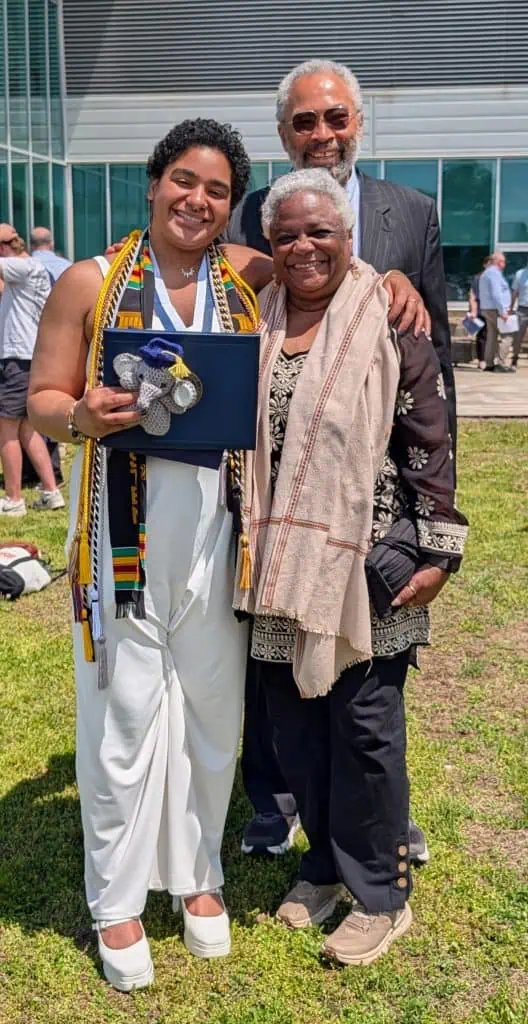
Photo by Bee Beckman.
The Crossover
Hold these two lives side by side, because they are married to each other.
Gwen began with all the optimism a child can hold. She believed in her potential. The brightest girl in the room, the outstanding student, Gwen knew she could do anything. And the country pressed on her until her strategy for staying alive became silence: keep your mouth shut, laugh a lot, do not see what you see. Roger began with no optimism at all, certain by eleven that the game was rigged, and the country pressed on him until his strategy became the opposite of hers: get angry where it counts, learn the tactics, stand as the steward and fight for what belongs to you and your people. Two brilliant, deeply loved Black children, born forty miles apart into the same Ohio, bent in opposite directions by the same pressure. They crossed past each other somewhere in midlife. Now, in their seventies and eighties, they hold the two halves of one survival together in a single marriage.
Gwen can see the shape of it herself. “The thing that stands out for me is that I will fight for other people,” she told me. “I see someone else in trouble, I will say, well, this is going to cost me, but I can’t let this happen. I will fight for other people, but I’m not gonna fight for me.” She will not even let Roger do it. “He’s my knight in shining armor, who wants to stand up and defend me. I’m like, nope. Let’s keep going. Let’s leave it alone. Let’s keep moving. We can put up with anything for an hour.”
The Testimony
When I asked what they felt when they heard what Anika had accomplished, the first word was instant. “Pride,” Gwen said, and Roger agreed. “Absolute pride. I didn’t have anything to do with birthing this person or raising this person, but I felt as proud as if they were one of my descendants.” And then, within minutes, with no nudge from me, the celebration became an argument with the present moment.
“We live in a world where the president says that only certain people should go to Princeton,” Gwen said. “Well, guess what? We know several people who have gone a whole lot higher than you said was possible for us, and we’re so proud of what they’ve done and who they are and how they’ve shown you don’t know what you’re talking about. So, why do you keep saying stupid stuff? That’s part of why we wanted to be there. To be among the hands that held them up and said, “Whoo hoo!”
Roger had been doing his own research. When the president dismissed Justice Ketanji Brown Jackson as “low IQ,” Roger went looking, and found a claim that has bounced around the internet for years. “I found out he was 364 out of 366 in Wharton School, and she graduated magna cum laude from Harvard. So, what does that say?” The exact ranking is internet lore. The documented record makes Roger’s point all by itself: the man who said it graduated from Wharton without honors. Justice Jackson graduated magna cum laude from Harvard. So did Anika, at Ithaca College.
And then Gwen gave me the refrain that named this article. I am keeping her repetition exactly as she spoke it, because the repetition is the point:
“Anika is a perfect example of, you don’t know what you’re talking about. We hear this every single day. You don’t know what you’re talking about. Well, here’s another example of you don’t know what you’re talking about. So, we know you’re going to keep talking, but we’re going to keep showing you, you don’t know what you’re talking about. The end.”
I asked what it meant to watch this young Black graduate move so far, so fast. “My heart is swelling,” she said, and I could hear it. “I’m holding back tears now. I want to yell, look at them, look at them, look at them running away from all that crap you’re throwing at them. You’re still slinging crap, and they’re like…” and she made the sound of someone dodging missiles and running free.
Then I asked how far we have come since she was Anika’s age, and the grief arrived in the same breath as the pride.
“I thought we would be the generation that ended all of that, and I feel sad that I didn’t do enough work, or our generation didn’t do enough work, or the system was too entrenched that no matter what we did, we couldn’t break that wall down. But I know that wall is not as strong as it has been, and as you want it to be, and Anika is another person that has created a weakness in that stuff that you keep throwing out to the generations.”
“It feels like another stone in the wall of, you don’t know what you’re talking about,” she said of the graduation. “I know you’re going to keep slinging those outrageous slings and arrows. I know that’s going to be part of my life while I have life. But you don’t know what you’re talking about, and I have proof of that. Here’s another example of proof of that.”
Every Black graduation in this country happens inside a four-hundred-year argument about whether Black people are fully capable, fully human, fully owed a place. The elders have spent their whole lives as exhibits in that argument against their will. On graduation day, they came to submit Anika, joyfully, as proof. That is what the cheering was, when our row rose up. Celebration, and rebuttal.
The Wall
Their testimony has numbers standing behind it, and the numbers tell the same double story: astonishing movement, and a wall being actively rebuilt.
First, the movement. In 2002, about 17 percent of Black adults twenty-five and older held a bachelor’s degree or higher. By 2022, it was nearly 28 percent, and the newest Census data put it at nearly 30. The share of Black adults holding advanced degrees more than doubled across the same twenty years, from about 5 percent to nearly 11.2 Every point of that climb is made of people: a Lois who got to finish, a Gwen who found support at the hard moment, a Roger whose aptitude was met with expectation instead of suspicion.
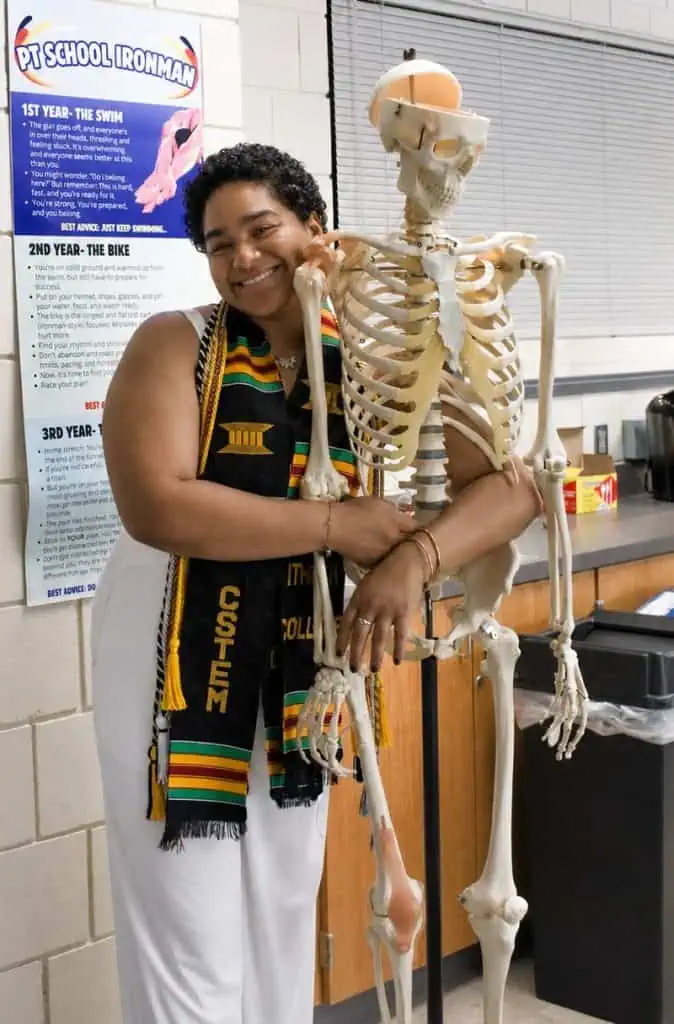
Photo by Bee Beckman.
Now, the wall. Anika is entering physical therapy, a healing profession where about 4 percent of practitioners are Black, in a country where Black people are around 13 percent of the population.3 The profession’s own association has named the pattern: physical therapy is rarely even presented to underrepresented students as a possibility, so few apply, fewer are admitted, and fewer still complete. Anika will spend their career being, in many rooms, the only one. The elders know what that costs. They have been the only ones in rooms for seventy years.
I keep returning to the college president on that stage, a Black woman opening her arms to draw Anika in. The hug was personal. It was also institutional: a school, in the body of its leader, telling a Black graduate, you belong here. That is the embrace this country is now withdrawing.
And the rebuilding of the wall is well underway. In June 2023, the Supreme Court struck down race-conscious college admissions, overturning nearly fifty years of precedent. Within a single year, Black enrollment in medical schools fell by 11.6 percent, and researchers writing in JAMA Network Open found that the declines among underrepresented students concentrated in states that had never banned affirmative action; in states with long-standing bans, the numbers barely moved.4 Here is the detail I cannot stop thinking about: applications from Black students rose that same year. The students kept coming. The doors changed.
That retraction has only accelerated. Since early 2025, executive orders have dismantled federal equity infrastructure piece by piece, including the rescission of the 1965 order that required affirmative action of federal contractors, an order that had stood for nearly sixty years under presidents of both parties. Some of these moves remain tied up in court as I write. The chilling effect is not waiting for the verdicts.
So when Gwen says she knows they are going to keep talking, she is describing the record. The argument is live, and the people who are making it hold power right now. That is the reality. Here is what the elders do with it.
Something Wrong With Them
Gwen has watched the same claims survive every disproof for three generations, and she has come to a conclusion about what that means.
“Y’all have been telling this story since I was a kid. You told my parents this story, you told their parents this story. And there’s something wrong with y’all, that no matter how much proof you’re provided with, you don’t let go of that stuff. And that helps me understand. It’s like when you’re dealing with a person who has an illness. You don’t beat them up for being ill. You recognize there’s something wrong with them. Sometimes you have to keep them on that side of the street, so they don’t contaminate you with whatever’s going on for them. Because the very proofs that they wanted, that they said would show them we weren’t as good as, we’ve shown them over and over and over again, and they hold on to that stuff.”
When she said it, something in me flinched, and then something else in me exhaled. For generations, Black excellence has been offered as evidence to a jury that was never going to deliberate. Meet the standard, and the standard moves. Produce the proof, and the proof is ignored. Gwen is describing the moment she stopped auditioning. If no amount of proof was ever going to be enough, then the deficiency was never ours. The condition lives in the people who cannot release the story, no matter what they are shown.
And her metaphor refuses two things at once. It refuses hatred: you do not beat up a person for being ill. The people caught in this condition remain human; in Dr. King’s vision, they too are future members of a Beloved Community we have not yet learned how to build. And it refuses self-abandonment with equal firmness: you do not keep handing your worth to people whose condition prevents them from seeing it, and you are allowed to keep them across the street while they are unwell. Compassion and accountability, held together in one image. Gwen arrived at it through a lifetime of practice, long before she ever found Nonviolent Communication, and it is as clear a piece of NVC consciousness as I have ever heard.
Her instruction for the young follows directly: “Maybe if we started with our children, telling them, look, you’re going to encounter some stuff out there, and it’s going to be painful, but it’s not you, it’s them. It’s okay. You keep doing you.” She came back to it again before we said goodbye, almost chanting: “I keep yelling, it’s not you, don’t think it’s you, it’s not you. I went through the same stuff. It’s not you, it’s them. You’re going to be alright. You’re going to be fine.”
Someone Has to Fight for Them
Now I need to tell you about the moment when the two interviews, conducted separately, days apart, with elders who never compared notes, arrived at the same place.
I asked my mother about the argument you hear everywhere now: that none of this is about racism, that people are just thin-skinned, that if everyone simply knew their own value we would have no need for affirmative action or equity programs at all. Lois, who had opened our interview telling me she never let racism touch her, did not hesitate. “I will say you are racist if you think that way. This is the way a racist talks, this is the way a racist thinks, and this is the way a racist acts.”
Then she did something more interesting than rejecting the argument. She took its one true grain seriously. Yes, she said, the person on the receiving end has to believe: “They have to believe in their values, they have to believe in their words, they have to believe in their accomplishments, and they have to believe that they are above what is being said to them about them.” She built her whole life on that belief, handed down from her mother’s kitchen. And then she named what the argument leaves out:
“We need affirmative action because no matter what, there are going to be a few who can’t step up to their belief in themselves, and we need people to fight for them.”
Why would someone struggle to believe in themselves? “Conditioning. The way they grew up, the influences they had. There’s some people who never had a positive influence, who were never told about their worth, never told about their value.”
Lois had the kitchen. Gwen had a mother who said nobody is better than you. I had Lois. And still, look how much each road cost. Now imagine the child who got the sticks every single year and went home to no one who could say it was the room, and never her. That is the child Lois is talking about. That is who equity programs exist for.
And here is the convergence. Gwen, in a separate conversation, in a different state, told me her anger only ever surfaces in defense of someone else: “I will fight for other people, but I’m not gonna fight for me.” My mother, when asked why we need affirmative action: “We need people to fight for them.” Neither knew what the other had said. Both, out of long Black lives from opposite ends of the diaspora, landed on the same truth. Individual brilliance is real, and Anika has it in abundance. And individual brilliance is not enough, because brilliance does not distribute belief in oneself. Belief is built, or withheld, by the world around a child long before that child can consent to anything. Where the world withholds the foundation, someone has to fight for the ones standing on air.
That is the case for affirmative action, for equity programs, for every scaffold now being pulled down, made by a 78-year-old who left school at thirteen and a 74-year-old who learned to keep her mouth shut to stay alive. The research happens to agree with them. They never needed the research.
And the four of them, driving across the country from Florida and from Ohio to sit in a crowd and cheer for one graduate, are what the fight looks like in its most tender form. Witnessing is an action. It is standing where a young person can see you, and reflecting back to them, in your own face, the worth this country keeps trying to talk them out of.
The Blessing
At the end of each interview, I asked what they would want anyone looking at this moment to hold. Their answers are for Anika, and for every young person walking into rooms that were never built for them.
Gwen: “If you’re doing the best you can, that’s good enough. No matter what they say to you, it’s good enough. You can do better, that’s great. If you can’t, it’s good enough, because you’re good enough.”
Roger: “Think of all the ways not to let somebody else define you. Define yourself.”
Gwen again, with provisions for the road: “Find something that gives you joy, something that will counteract that bitter taste that interacting with folks who have something wrong with them can leave for you. Make sure you got ice cream over here, and candy over here, and something wonderful, hugs over here, and dreams over here that keep you going, because you’re going to need those sometimes. But you’re loved, and we know that you can do what it is you set your heart to do. We’ve got plenty of examples of that, and you’re no exception.”
And Lois, who paved the ground her children and grandchildren walk on: “Right now, I’m the matriarch of the family, and I will always be proud and happy to see those who come after me accomplish a whole lot more than I did.”
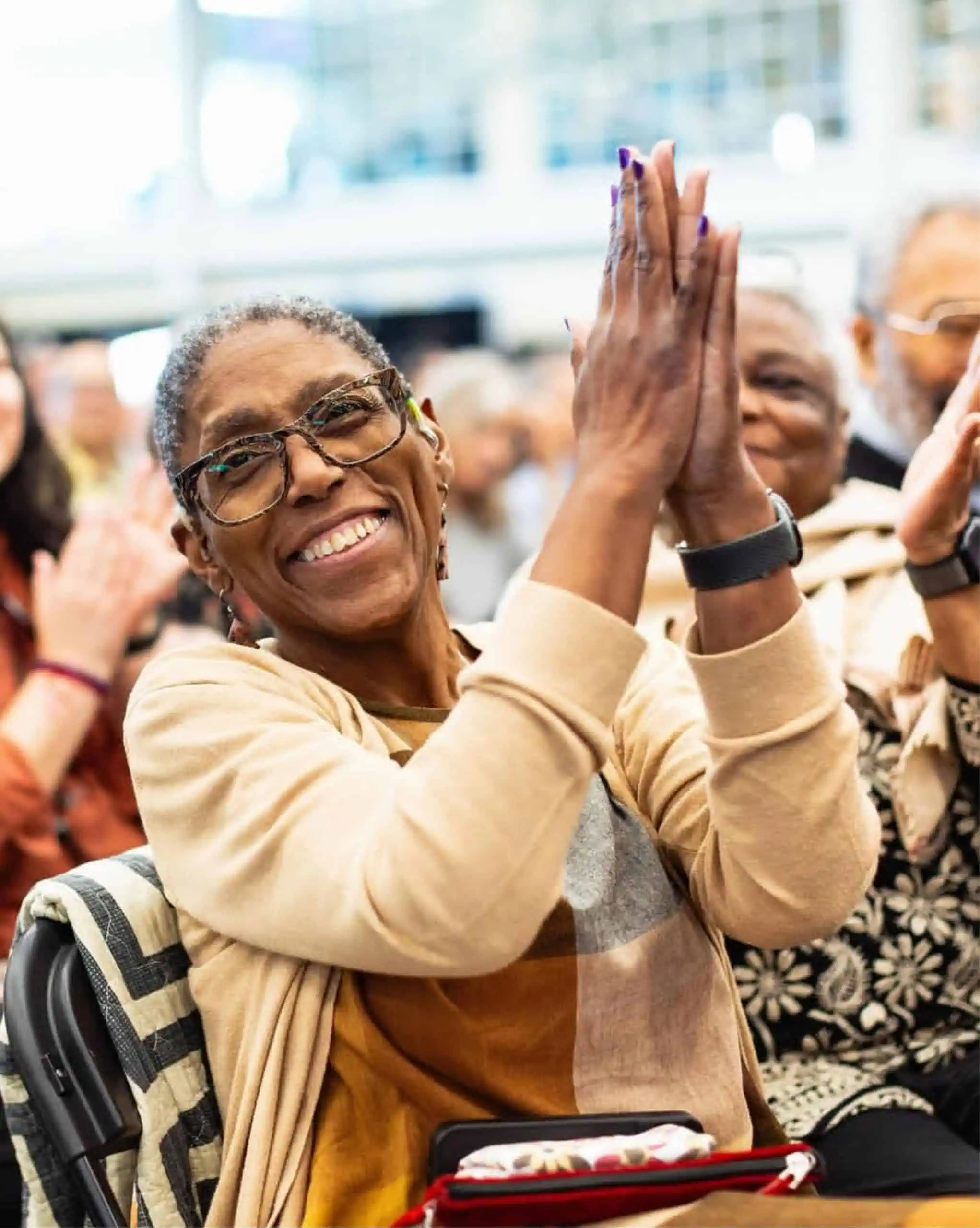
All through the ceremony, the college’s photographer kept circling back to our family. That evening, one of her pictures appeared on the college’s Instagram feed: me, mid-clap, hands raised, beaming through a cold and pink eye, surrounded by my elders. I understand why she kept coming back. She was watching four people witness.
The wall they keep rebuilding is weaker than it was. And Gwen is building a wall of her own, stone by stone, graduation by graduation, out of proof. Anika is in it now. My son, Theo, is in it. A great-granddaughter weeping over a B is in it. Four elders drove across the country to watch the newest stone set, because they understand something the people still slinging crap have never learned: we can lift each other up. We can celebrate each other. We can see what the world refuses to see, and say it out loud to each other’s faces.
They came to witness. Now you have too.
Sources
1. National Student Clearinghouse Research Center, Yearly Progress and Completion, fall 2019 cohort; figure for Black students as reported by the Journal of Blacks in Higher Education.
2. U.S. Census Bureau, Current Population Survey, as compiled in the American Council on Education, Race and Ethnicity in Higher Education: 2024 Status Report, Table 1.2; 2024 figure from Census data reported by the Journal of Blacks in Higher Education.
3. American Physical Therapy Association, A Physical Therapy Profile: Demographics of the Profession, 2021–2022.
4. Association of American Medical Colleges applicant and enrollment data; Florescu et al., “Affirmative Action Repeal and Racial and Ethnic Diversity in US Medical School Admissions,” JAMA Network Open, 2025.
The elders’ words come from recorded interviews, lightly trimmed for readability, and are shared with their consent.